Five Cards of Hope — strengthening your hand when hope runs low in your life or our world
When you look at the future you, or we, are heading into, do you feel hopeful?
If you don’t, you’re not alone. Widespread loss of hope is a feature of our time.
What helps us face this, or support others feeling this way?
In the summer of 2023, I discovered a word I’m finding so very useful here when I read an article in Permaculture Magazine by Manda Scott called ‘Thrutopia – creating a new story for a world in transition.’
A utopia is an idealised state where everything is running well – but it is so perfect it seems impossibly out of reach. It is hard to believe in.
A dystopia, on the other hand, is an awful state where things have worked out badly. There’s plenty of that already here, and also widespread fears of more to come. Just look at how the future is portrayed in modern cinema and popular imagination, a Mad Max world, or Terminator, or the Handmaids Tale. Perhaps these are warnings of where we could be headed if we don’t find a different path.
Recognising the need to develop a different way of thinking about the future, philosopher and activist Rupert Read coined the term ‘thrutopia’ to describe a narrative of making it through difficult times in the best possible way.
There are several key elements to this Thrutopian Story pattern.
First is that it starts from where we are right now, in the present.
And in that present, there’s recognition of something difficult for us to make it through.
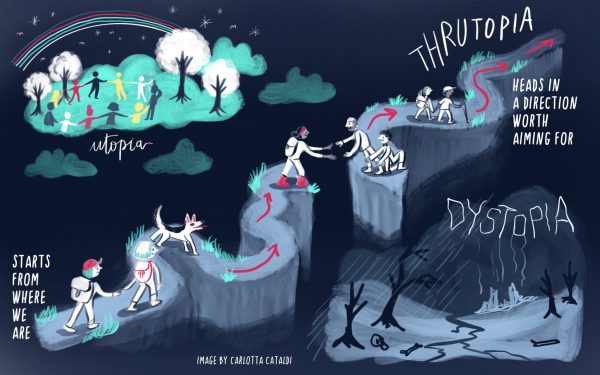
The plot is about how we do that in the best possible way, heading in the direction of a future worth aiming for, finding our strengths and solidarity, as we each seek out and play our part. There’s no guarantee we will make it through in ways we hope for, but if we show up as best we can in support of that intention, we’re more likely to head that way.
We can apply this thrutopian story pattern to facing loss of hope. How do we make it through times of hope collapse in the best ways possible? Over the last few years, I’ve refashioned my resilience training work to address this question. And at the heart of a thrutopian approach to resilience is a redesign of hope itself. The central insight is that hopefulness is just one form of hope, and if we lose this, there are other forms still available that can usefully nourish, guide, resource and inspire us. I’m building here on the work I did with Joanna Macy, described in our book Active Hope. There’s also new ground that has opened up since then, and the framework of Five Cards of Hope offers an accessible way of describing this.
The First Card is Hope as a Feeling
The commonest question I’m asked about hope is ‘Are you hopeful?’
My answer isn’t just yes or no, it is more like a scale that runs from high to low, as my feeling of hopefulness rises and falls.
Coming tomorrow – completing the post about the other cards of hope, including a short video.